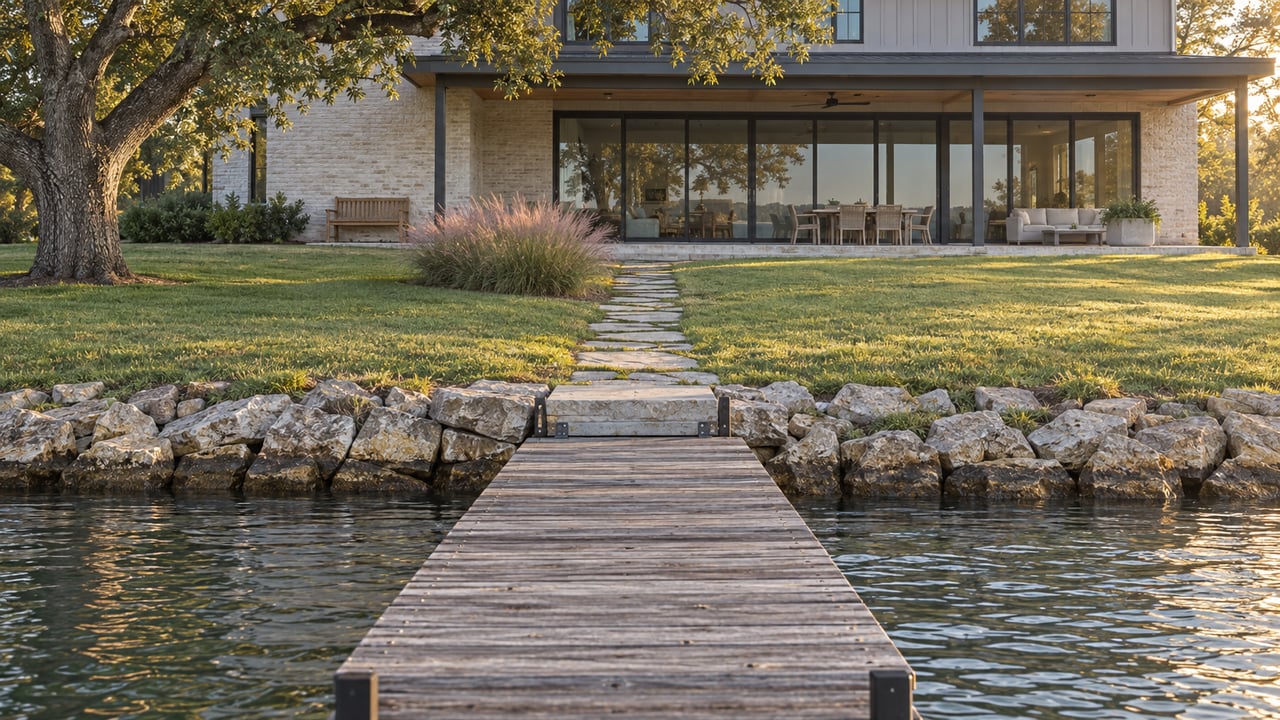
The listing photo does its job. Morning light on the water, a covered slip, a dock running out toward open lake. What that photo does not show is the file sitting in a drawer at the San Jacinto River Authority's Lake Conroe Division, and whether that file still says the structure is allowed to exist.
That distinction is the whole story on Lake Conroe. The San Jacinto River Authority, which manages the reservoir, states plainly on its residential licensing page that the right to build, operate, or maintain a private dock or bulkhead is not something that comes automatically with owning waterfront land. It is a license SJRA issues, and a license SJRA can revoke. A dock without a current file is a dock the reservoir manager can order removed. Once you know that, a Lake Conroe waterfront transaction stops looking like a real estate deal with a water view attached and starts looking like a deal with a second, unpriced asset buried inside it: the paperwork.
What Happens When the Permit File Doesn't Show Up
During the option period, a buyer's agent will ask for the SJRA permit number and copy for every dock, lift, and bulkhead on the property. If the seller produces it, that part of the negotiation is closed. If the seller cannot, the deal does not fall apart, but it does reprice. The buyer either asks the seller to open a reapplication with SJRA before closing, or the buyer absorbs the risk themselves and adjusts the offer downward to cover it. The final number on the settlement statement gets set at that moment, not on the day the home was listed.
Permit transferability adds another layer. Some SJRA licenses transfer to a new owner with simple notice. Others require the buyer to reapply from scratch, and a reapplication puts that structure in front of whatever rules are current today, not the rules under which it was originally approved. If a dock happens to be wider than today's setback allows, a reapplication is exactly where that gap surfaces, and it surfaces on the buyer's clock, not the seller's.
None of this shows up in a photo. It shows up in a folder, or it doesn't.
The HOA Layer Nobody Reads Until Resale
A current SJRA permit is necessary. It is rarely sufficient. Most Lake Conroe waterfront lots sit inside a private subdivision, and that subdivision's architectural review committee frequently sets standards stricter than SJRA's own minimums.
Bentwater, a 1,400-acre gated community running along 12.5 miles of Lake Conroe shoreline, reviews dock and shoreline design through its own ARC before SJRA's rules ever enter the conversation. Walden, the largest community on the lake, is organized into multiple sections with separate governance documents covering vacant lots, single-family homes, townhomes, and condominium units, which means a listing with a shared dock or community slip raises a second question: which section's rules apply, and is an assessment pending against that structure. April Sound layers its own architectural review on top of the SJRA license, and if a prior owner built or modified a dock without getting that ARC signoff, the gap tends to surface exactly when the home goes back on the market. Cape Conroe, a canal-front community, carries an added question most open-water lots never face: a history of dredging permits tied to keeping the canal navigable.
Two properties with identical SJRA paperwork can still carry very different resale risk depending on which of these governance structures sits on top of it.
The Lake Itself Doesn't Hold Still
Even a fully permitted dock has to survive a reservoir that is managed, not fixed. Lake Conroe's normal conservation pool is 201.0 feet above mean sea level, with the spillway sitting at 207 feet. Since 2018, SJRA and the City of Houston, which owns two-thirds of the reservoir's water rights, have operated under what SJRA calls Active Storm Management. Between April 1 and June 1 each year, the City of Houston can request diversions that draw the lake down toward 200.5 feet to create storm capacity ahead of forecast rain. A drought contingency plan triggers watering restrictions at 199 feet.
That range shows up in the data even in an ordinary year. As of July 4, 2026, Lake Conroe sat at 98.9 percent full. By August 2, it had eased to 98.7 percent. By September 13, it was down to 94.8 percent full, according to Water Data For Texas. No named storm forced that slide. It is the reservoir doing what a managed reservoir does across a normal Texas summer, and it is the same elevation swing a fixed-height dock has to tolerate every single year, not just during a declared emergency.
There is a reason to expect more coordinated management going forward, not less. In July 2026, Community Impact reported that SJRA, the City of Houston, and the City of Humble launched a $1 million joint operations study to coordinate pre-releases between Lake Conroe and Lake Houston once eleven new spillway gates come online at Lake Houston, lifting that reservoir's discharge capacity from 10,000 to 78,000 cubic feet per second. The motivation is not abstract. In August 2017, Lake Conroe came within a foot of its own spillway elevation during Hurricane Harvey, and SJRA's release, peaking near 79,000 cfs over 36 hours, contributed to downstream flooding in Kingwood and Humble that damaged more than 3,000 homes. A study designed to coordinate two reservoirs more deliberately is a study designed to avoid a repeat of that sequence.
For a buyer, the practical question is simple and rarely asked before an offer goes in: was this dock, gangway, and bulkhead cap engineered for a static 201-foot pool, or for a lake that regularly operates a foot or more below that. A seller who can answer that question in writing is negotiating from a stronger position than one who cannot.
What This Looks Like Across a Few of the Lake's Communities
The paperwork question changes shape depending on which stretch of shoreline you're looking at.
| Community | What's Different | Extra Layer to Verify |
|---|---|---|
| Bentwater | 1,400 acres, 12.5 miles of shoreline, golf and marina amenities | ARC design standards, often stricter than SJRA minimums |
| Walden | Largest community on the lake, multiple sections plus condo associations | Which section's governance applies, pending assessments on shared docks |
| April Sound | Architectural review layered on the SJRA license | Whether prior shoreline work has ARC signoff on file |
| Cape Conroe | Canal-front lots | History of dredging permits to keep the canal navigable |
| Water Crest | Newer construction, mix of gated lakefront and interior sections | Whether the specific section includes a private dock or relies on the shared community boat launch |
A home in Water Crest with community boat launch access carries almost none of this friction. A home on a Cape Conroe canal does, and the friction is different again from a Bentwater lot inside a gated ARC. The address matters more than the word "waterfront" does.
Before You Write the Offer or List the Home
For buyers:
- Request the SJRA permit number and a copy of the license for every dock, lift, and bulkhead on the property.
- Confirm with SJRA directly whether that permit transfers with the sale or requires notice or a fresh application.
- Order a current survey showing the structure relative to the ordinary high-water line and any shoreline easements.
- Hire a marine contractor to inspect pilings, decking, fasteners, and lift mechanics before the option period closes.
- Ask the HOA or ARC for the current design guidelines, not last year's, and confirm no violations are outstanding.
For sellers:
- Open a dialogue with SJRA before listing to confirm license status in writing, rather than letting the buyer's agent discover a gap during the option period.
- Pull architectural approval records from the community office for any dock or bulkhead work completed while you owned the home.
- Disclose honestly whether the structure was engineered for the historic static pool or accounts for the seasonal drawdown range the lake now regularly sees.
Does a valid SJRA permit guarantee the structure can stay exactly as built. No. SJRA reviews new and modified structures against current rules at the time of that review, which can require design changes even for a structure that was properly permitted years earlier.
Is a canal lot regulated the same way as open-water frontage. Legally, yes, both fall under SJRA jurisdiction. Practically, canal lots trade wind and wake protection for shallower water and tighter maneuvering, and depth at the bulkhead matters more than the neighborhood name on the sign.
The dock in the photo is real. So is the water. What actually decides whether a Lake Conroe transaction closes on schedule and at the number both sides expected is the file that says the lake will let that dock keep existing, and whether anyone checked it before the ink dried.
If you're weighing a purchase or a listing on Lake Conroe and want a clear read on what a specific property's permit history and shoreline paperwork actually look like before you write an offer or set a price, The Lux Team can walk through it with you. Request a White-Glove Consultation and we'll help you get the file in order before it becomes a negotiating point.